For fifteen years, I believed traditional health insurance was the responsible choice. You paid the premium because going uninsured felt like one accident or one diagnosis away from financial ruin. But after years of rising premiums, high deductibles, a $26,000 birth, and a $3,000 bill for a miscarriage I was still grieving, I finally started questioning whether the system I was so afraid to leave was actually protecting us.
Four months ago, our family canceled our traditional health insurance and joined CrowdHealth instead. So, I wanted to share an honest CrowdHealth review of why we made the switch, what we’re paying now, and what the experience has actually looked like for our family.
We are a family of four, I run my own business, and I’m the primary income earner. On paper, that decision should terrify me. Instead, it’s honestly the lightest I’ve felt about our health finances in years.
A quick note: I’m a designer and a business owner, not a doctor, an insurance agent, or a financial advisor. This is my family’s personal experience, not medical, insurance, or financial advice. CrowdHealth is a cost-sharing community, not insurance, and it isn’t right for everyone. Please read their eligibility terms and talk to a qualified professional before making changes to your own coverage.

Let’s Go Back…
I started paying for my own insurance in college. I was 20 or 21, paying about $150 a month, and I remember opening a letter that said my premium was jumping to almost $500. The reason? I was a woman in my “childbearing years,” so I was labeled a maternal risk.
The irony is that the plan didn’t even cover maternity care. Neither did most plans for people my age back then. Women were routinely charged 50 to 81% more than men the same age for coverage that excluded the exact thing we were being penalized for. [resource here ;) ]
I was about to graduate into one of the worst recessions in modern history, and I was being asked to pay double for a risk the plan wouldn’t even cover. So I did the responsible thing.. I found a plan with a higher deductible and a lower premium. It was the trade-off I was willing to make.
That became the theme for years. Do the responsible thing.. get “punished” for it anyway.
The Obamacare Mess
Then the ACA arrived, and for a minute it helped.. I was excited. I qualified for some subsidies. But the experience was a mess. The website crashed constantly. Every year I had to hand over what felt like my entire life story or my firstborn to re-enroll, then spent hours confirming which doctors were actually in-network before I could even think to head to the clinic. And let me tell you, out-of-network is $$$.
Each year the price went up. And up. And up.
When my husband left his job and I started covering both of us, the numbers stopped making any sense at all. We were two healthy adults who never went to the doctor. Why aren’t we being incentivized for that? Instead, I felt like we were being punished.
Then COVID hit, and the subsidies expanded, which sounded great… until I crossed over the poverty-line threshold. Which meant my subsidy dropped to zero. I was back to paying full price. This is the part my self-employed readers can relate to: you can earn too much to get help and still not earn enough for it to feel affordable.
With my high premiums and deductible, I stopped going to the doctor. I once let a sinus infection go untreated, which led to a double ear infection.. all because I didn’t want the bill. 🫠
One positive: you can use the premiums as a business write-off and contribute to an HSA for additional write-offs. However, I would MUCH rather pay a lower premium, if I’m being honest.
A $26,000 birth and a $3,000 miscarriage
In 2023 I had my first daughter. I planned an unmedicated vaginal birth for a lot of reasons, and I’ll be honest that cost was one of them. I knew every drug and intervention would add to the bill. At the time, we were paying over $1,200 a month in premiums, with deductibles over $10,000 for each of us.
The birth cost around $26,000. We are still paying off our $10,000 share, plus more, because my newborn daughter had her own separate bills.
Then we got pregnant again… but miscarried. On top of the grief, I got a $3,000 bill for my emergency visit. The crazy thing is, that’s considered low cost for what I went through; it could have been much higher if I needed a D&C.
When I miscarried a second time, I didn’t even go in. I stayed home and hoped my body would handle it on its own, and thankfully it did. I’m kind of embarrassed to even admit that, but I have a feeling I’m not the only woman who has made a medical decision around a bill instead of around her health. Which sucks.
Then I started asking harder questions. Would my insurance cover a fertility specialist? No. Additional testing? No. Extra ultrasounds? No. So I stopped asking, and I started going to a family clinic and paying cash, and somehow that was cheaper than using the coverage I was paying a fortune for.
The Switch I Was Scared to Make
When I got pregnant with my rainbow baby, I opted out of going to the hospital and chose a birth center (and paying cash). Part of that was because it fit the redemptive birth I wanted, and part of it was the math. The birth center was $7,000 versus $10,000+ through the hospital.
Here’s the part that makes me wish I’d taken the leap sooner…
My midwife told us about CrowdHealth, but I was too scared to do it. We grew up being told we NEEDED to be covered or doom was coming, and I couldn’t get past that voice for a VERY long time. So we kept paying premiums, kept funding the HSA, and kept paying cash for everything on top of it. Woof.
I could get an ultrasound at a private imaging company for $400, or go through the hospital and pay over $800 after insurance. I kept choosing the cash option, even while paying for insurance I was actively avoiding. It was silly, and I knew it, but we did it anyway for a long time.
Why We Finally Canceled
The tipping point was our newborn, Collins.
After she was born, we could add her to our family insurance plan, which would push us to $1,600 a month. She was one month old and uninsured. Was now the time to make the leap? Cancel our insurance?
I was so tired of cringing every single time we made a payment or had to schedule an appt. So we did it. We canceled our insurance and signed up for CrowdHealth as a family. My midwife had a referral, which made it even easier. And today, after having it for almost 4 months, I’m comfortable sharing my experience and my referral link with you today :)
What We Actually Pay Now
First, the terminology: CrowdHealth is not insurance. It’s a medical cost-sharing community (ie: considered “uninsured” to the healthcare system), which means members fund each other’s bills directly instead of paying a carrier.
Here’s what it looks like on our budget:
We pay a $40 monthly membership fee per person (because I used a referral discount ;), so $160 a month for the four of us. On top of that, there’s a maximum monthly contribution of $420 that goes toward other members’ bills. So the most we would ever pay in a month is around $580. Next month, we will go back to the normal $60 per-person membership fee, so realistically, from that point on, we will max out at $660/mo.
But we rarely hit that max, because the “crowd” doesn’t always need the full contribution. Some months it lands closer to only $410.
Now compare that against $1,600 a month with $10,000 deductibles, and my eyes were completely opened.
Instead of my bills going towards my high deductible, every medical issue is treated as an “event” with CrowdHealth. Any event over $500 gets submitted to the crowd for funding “coverage”.

What That Looked Like for Us.
To give you an idea, here’s what’s happened with us in the last few months.
- My daughter had a dental cleaning package that ran $400 for the year. I used her $300 annual health credit (each of us gets $300 a year toward physicals and preventive care), so we paid $100 out of pocket. yay!
- Her regular checkups at the family clinic are $60 in cash, and we pay cash for extras like vaccines or tests.
- When she had a strange cough, we used the virtual care option. The visit was $150 and was fully reimbursed within about a week. As all virtual care visits are ;)
- I got mastitis and went to urgent care. The visit was $300, and with the uninsured cash discount I paid $117. For comparison, the last time we took my daughter to that same urgent care while insured, it was $330, and we still owed $216 after insurance.
- If my mastitis follow-up appointment puts me over $500, I’ll just submit it as a health event, so we’ll pay the first $500 and anything after will be submitted for crowdfunding.
I also have a possible ultrasound coming up. For something like that, I submit the reason and a cost estimate, and if it’s approved, they send a voucher check to cover it before I go. WHAT!?
One thing I didn’t expect to love: the program actually rewards you for being healthy. You can get discounts for doing additional testing that proves you’re in good health. After fifteen years of a system that only ever charged me more, no matter if I was healthy or not, felt so refreshing ;)
And here’s the regret I mentioned earlier. If I had joined last year.. my birth and prenatal care would have run closer to $3,000 instead of the $7,000 we paid, because postpartum care is eligible too. Members have reported coverage for things like lactation consultants, doulas, and pelvic floor therapy! I legit left so much money on the table out of fear, and THIS is why I wanted to share.
It’s Not for Everyone
I want to be clear that this was a really scary leap for us, but it also made the most sense for my family. Having little kids adds an extra layer, but honestly, the CrowdHealth advocates have been amazing to work with and have put me at ease. Because this post has a referral link, I want to make sure I explain how it works.
This isn’t the right move for everyone, since cost-sharing communities don’t always cover autoimmune or pre-existing conditions, and that’s a big deal for a lot of people. If you or your family have ongoing medical needs or are over a certain weight, make sure to read the eligibility terms closely and talk to someone (they make it easy to schedule a call).
I Love Seeing Where My Money Goes.
With insurance, my money disappears into a company whose entire job is to collect more than it pays out. With this, my contribution goes to a real person. In July, $160 went toward a birth in Texas. In August, it was a shoulder surgery in Tennessee. I’m okay with that, because when our turn comes, and eventually it will, someone else’s contribution shows up for us.
They also share monthly funding stats. Here’s an example of July.
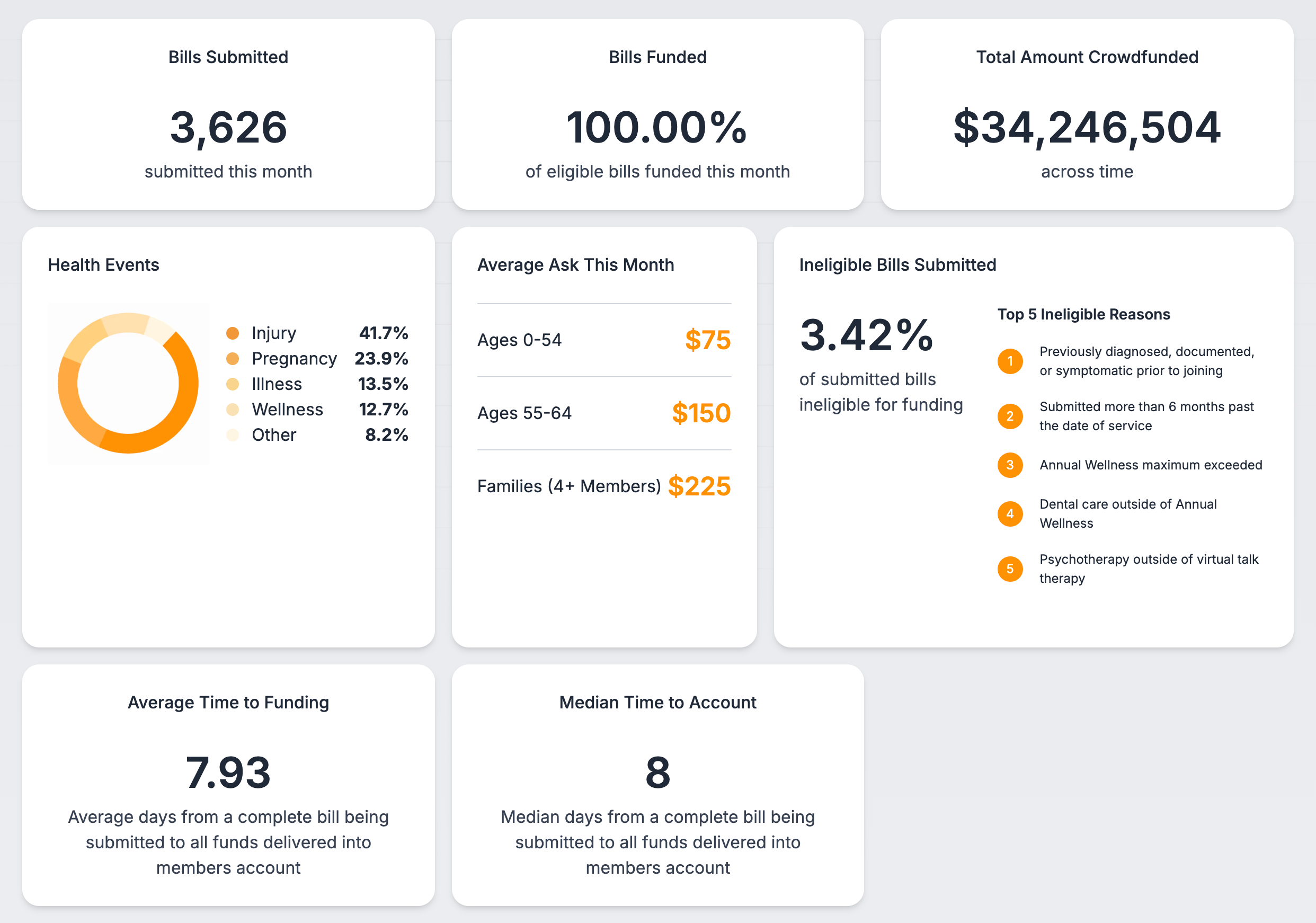
We’re heading into our fourth month, and we could not be happier that we finally did it.
One last thing :)
I’m not telling you to cancel your insurance at all.. this is just my experience that I thought is worth sharing. However, I am telling you it’s okay to finally question a belief you’ve spent years slightly avoiding.
For fifteen years I did everything I was told, and it still cost me a birth I’m paying off. And, honestly, I consider myself to be very lucky with just that bill.
Sometimes the responsible thing and the thing we were told to do are not the same thing.
So, as a business owner, a mom, and a woman who will probably be heading right into perimenopause after I’m done nursing. I wanted to share this with you.
P.S. Below is a referral link if you want to use it, which gets you three months of discounted advocacy fees for your family. Just so we’re clear: I may receive a benefit if you sign up. :)
If you click on my affiliates/products/advertisers links, I may receive a tiny commission. P.S. the products that I share are the ones I believe in.